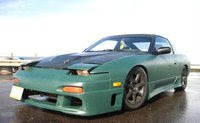
Hello All!
I've been back in the states for about a month and some change, and have been out of the Marine Corps for about as long. I've been settling down for a little bit and getting my 240sx back up to good running condition. Got a few quirks in it, but working on it little by little.
I will post up new blogs starting next week (after 23rd of February). Getting ready for a drift event on the 22nd up at Orange Show Speedway. I am currently with Team Thursday Knights and helping them coordinate events and working with their media crew.
If you have any questions, please feel free to email me at anthonyhomir@yahoo.com
I have not forgotten Mainichi Tuning... I've just been on a little hiatus. Please bear with me, and there will be new informational posts soon!!!!!
-Mainichi Tuning
Tuesday, February 17, 2009

Sunday, November 30, 2008
Thank you Aaron
I'd like to say thank you to Aaron for being the first to post a comment on the Mainichi Tuning Blog. It's always nice to hear from others that my car geek studying and research is helping them in some way, shape or form.
If you would like to post a comment, you do not have to be a blogspot user, all you have to do is click on the "comment" link and type away.
I'm currently getting ready to pack for my move back to California from Okinawa. I may or may not have time to post up anything new or cool till I get a few things handled and out of the way. I will post when I have free time though.
Hope everyone stateside had a Happy Thanksgiving and got fat and happy off all that turkey and ham!
-Mainichi Tuning
If you would like to post a comment, you do not have to be a blogspot user, all you have to do is click on the "comment" link and type away.
I'm currently getting ready to pack for my move back to California from Okinawa. I may or may not have time to post up anything new or cool till I get a few things handled and out of the way. I will post when I have free time though.
Hope everyone stateside had a Happy Thanksgiving and got fat and happy off all that turkey and ham!
-Mainichi Tuning
Tuesday, November 11, 2008
Mix and Match
Mixing and Matching Camshafts

Camshafts are the long metal rod-like objects that run the length of your engine within the valvetrain of your cylinder head. Camshafts have lobes that have an egg-shaped profile when you look at from a lengthwise view. The lobes push down on your intake and exhaust valves inside the cylinder head allowing air to enter your engine's combustion chambers and to let exhaust gases exit your combustion chambers.

Camshafts are measured in duration (the taller the height of the lobe = the valves are open longer allowing more air to enter and exit the combustion chambers). Stock camshafts from factory are generally mild and are designed with fuel economy and driveability in mind. More aggressive camshafts have higher duration lobes and are used to alter your engine's powerband. When I say altering your powerband, I'm talking about where your engine makes power along the RPM range. If you have crazy high duration cams, you need to rev higher in order to access and utilize the powerband which has been moved up the RPM range.

Mad High Duration Cams = Revving higher in order to make power. Applications with very high duration cams usually have balanced and blue printed engine internals, upgraded valvetrain, ported and polished headwork, ecu tuning, etc in order to safely rev at higher rpm.
Having an engine that revs that high, you most likely will kiss emissions goodbye and low-rpm driveability out the window.
Mild Duration Cam set ups are used to compliment an engine's powerband and alter it slightly in order for power to be made across a larger portion of the rev range including a combination of low and mid or mid and high rpm.
KA24DE Cams
There is a total of 3 different cam durations for the KA24DE engines coming from the S13 and S14 240sx.
S13 240sx
Intake: 240 degrees
Exhaust: 248 degrees
S14 240sx
Intake: 232 degrees
Exhaust 232 degrees
DjPantsSpecR from Nicoforums has attributed his findings through vigorous testing of different stock cam combinations to KA24DE engines with both the 4-speed automatic and 5-speed manual transmissions. Gearing is different between the automatic and manual transmissions. Certain combinations will work better for an automatic vs the manual and vice-versa.
my comments on 248/240 s13 cam swap
by DjPantsSpecR
[excerpts]
The following are cam duration combos labeled as such:
***/***
The first 3-digit number denotes the Intake Camshaft Duration and the second 3-digit number denotes the Exhaust Camshaft Duration
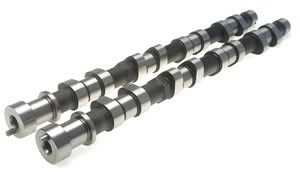
Camshafts are the long metal rod-like objects that run the length of your engine within the valvetrain of your cylinder head. Camshafts have lobes that have an egg-shaped profile when you look at from a lengthwise view. The lobes push down on your intake and exhaust valves inside the cylinder head allowing air to enter your engine's combustion chambers and to let exhaust gases exit your combustion chambers.
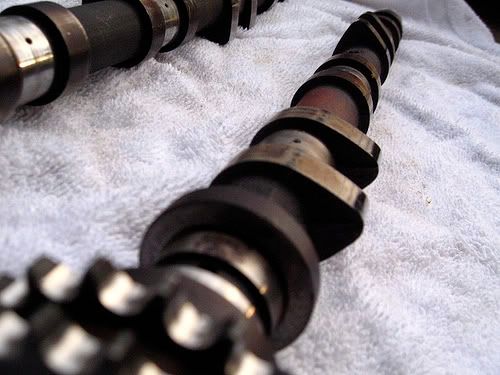
Camshafts are measured in duration (the taller the height of the lobe = the valves are open longer allowing more air to enter and exit the combustion chambers). Stock camshafts from factory are generally mild and are designed with fuel economy and driveability in mind. More aggressive camshafts have higher duration lobes and are used to alter your engine's powerband. When I say altering your powerband, I'm talking about where your engine makes power along the RPM range. If you have crazy high duration cams, you need to rev higher in order to access and utilize the powerband which has been moved up the RPM range.
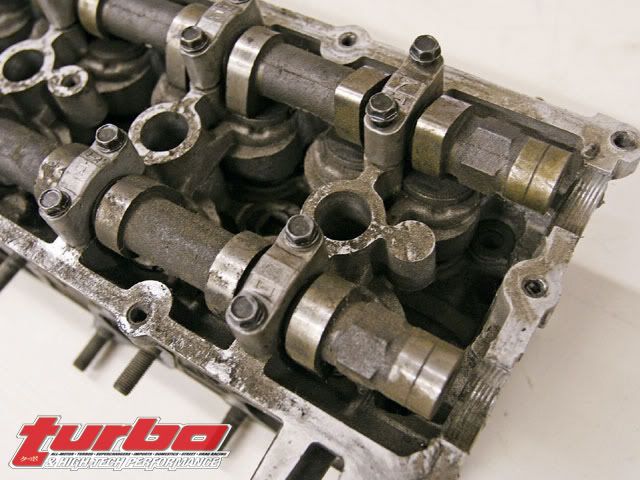
Mad High Duration Cams = Revving higher in order to make power. Applications with very high duration cams usually have balanced and blue printed engine internals, upgraded valvetrain, ported and polished headwork, ecu tuning, etc in order to safely rev at higher rpm.
Having an engine that revs that high, you most likely will kiss emissions goodbye and low-rpm driveability out the window.
Mild Duration Cam set ups are used to compliment an engine's powerband and alter it slightly in order for power to be made across a larger portion of the rev range including a combination of low and mid or mid and high rpm.
KA24DE Cams
There is a total of 3 different cam durations for the KA24DE engines coming from the S13 and S14 240sx.
S13 240sx
Intake: 240 degrees
Exhaust: 248 degrees
S14 240sx
Intake: 232 degrees
Exhaust 232 degrees
DjPantsSpecR from Nicoforums has attributed his findings through vigorous testing of different stock cam combinations to KA24DE engines with both the 4-speed automatic and 5-speed manual transmissions. Gearing is different between the automatic and manual transmissions. Certain combinations will work better for an automatic vs the manual and vice-versa.
my comments on 248/240 s13 cam swap
by DjPantsSpecR
[excerpts]
The following are cam duration combos labeled as such:
***/***
The first 3-digit number denotes the Intake Camshaft Duration and the second 3-digit number denotes the Exhaust Camshaft Duration
248/248 is by far my least favorite cam swap. there is a noticeable loss in low end, and the motor never rev's high enough to take too much advantage of the additional top end power. I'm not saying the top end isn't there, it just really only starts pulling until right before 6000 rpm, and pulls to 7000. then you hit the rev limiter and crave for a few more revs. maybe an automatic ecu and 7200 rpm might be beneficial, but i love to rev it out and i shouldn't be allowed to have 200 more rpm. if i had a more top end oriented motor 248/248 would be a great thing to have, but until i can afford it, i wont ever use it again. the sound you get from this beast is nice though
240/248 is obviously stock, its been a while since I've actually had a car with 240/248. but from what i remember the low end is decent but it does fall on its face in the top end. the 248 exhaust cam is trying to make top end power, but the 240 intake cam is trying to provide more all-around power, not just low or top end. i don't like it because of how bad it falls on its face before even 6500
232/232 i never tried, but i got em so i could.... but come on 232/232?
240/240 has a really snappy low end, probably the best low end I've tried, and its the only times I've ever spun the tires into second gear in the automatic, granted its gotta be wet outside... any who, 240/240 is what I'm directly comparing to 248/240 here. 240/240 has a nice pull even in the top end, and power is quite prominent in the 4000 rpm area. I'm still a big fan of 240/240 and I'd like to try it on my manual car, but that car already has the hands down best stock cam swap possible....
248/232 this is hands-down where its at. If you have some s13 cams and some s14 cams you should have already done this. the power production is great everywhere. you only lose a little bit of top end over 248/248 and you gain more low end than you get with any other swap besides maybe 232/232. the KA craves this swap, it loves the low end and, chances are you only rev to 6500 anyway, so that's why this is the cam swap for you. only don't do this if you wanna get beat by me. I'm only kidding, I'm too poor to be fast.
248/240 you read all that crap just to get to here so here it is. coming from 240/240 in a nearly stock automatic car, I'm very disappointed. the only major difference is a slight gain in top end, maybe 2hp, but the loss of low end is noticeable. I'd rather have that torque back for this daily driver than the slight bump i got in top end. granted this car is actually proven quicker now than the 240/240 car, but its less satisfying. everyone wants to be put into the back of their seat right away, not eventually.....
sound in 248/248 sounds the best, but 248/232 sounds 100% different, and also quite beautiful. idle with 248/240 sucks, but its nice because its honestly lobing so it give the illusion of a fast auto....
EDIT: okay this is the only swap i think i didn't touch yet, and you wont even hear about for many posts down. Some of the posts in this thread are kinda off topic, but MANY MANY are very useful, and there is a large discussion independent of this thread by tloof that you can search for...
240/232 this is what i just put in my automatic car. I'm a huge fan of the low end here, and its better than 240/240. the overlap is always off by about 2 degrees or so when you use an intake cam used as an exhaust cam or vice-versa. So for that reason, 240/232 works very nice. i can tell it doesn't have quite as much pull in the top end as 248/232 but its part-throttle driveability is great. you really only feel the low end torque when you are at part-throttle anyways, so you need to make a decision....
240/232 is great for a daily driver, where low end torque is favored over top end merging power. in the automatic, after shifts the car has noticeably more power than it does with 248/232. I would say if you have an automatic get the 240/232 because you spend more time in the mid range because of your gearing.
248/232 is for the manual car. I've gone to and from this cam swap in both cars at least five or six times, and i always come back. its the best there is, and its greater than stock. its ideal for forced induction, and its cheap to do. i can imagine this swap would be even more devastating with a re-drilled cam gear.
248/248 is something I'm going to look at again with my current setup on the manual car. (re-drilled cam gear, intake manifold, SAFC, 3in exhaust, and dc sports header) it doesn't do any good in the auto, the loss in mid and low end isn't worth it. I've seen a dyno of 248/232 vs 248/248 and the difference in top end is something like 2hp, but the difference in mid range is 6 peak hp and all kinds of torque.....
-Mainichi Tuning
S13 Firewalls
S13 Firewalls were pre-stamped for RHD. All you need to do is drill out a few spot welds and drill some mounting holes out.
Wednesday, October 29, 2008
Taking a little break
Taking a little break from posting on blogspot. Expect new posts sometime in November.
Saturday, October 4, 2008
Engine Management
Perfecting the Tune
Making more power out of your engine can be done through many different ways. You can slap some bolt-on power-adders, add forced induction to a naturally aspirated engine, upping the compression ratio of your engine through upgraded cylinder block internals, port and polishing your cylinder head, etc. In order to make these power adders as effective as possible, it is necessary to tune your engine for the parts. Tuning an engine, in simple terms, lets the engine run making the most power as safely as possible or as to your liking.
On modern day fuel injected vehicles, the engine is controlled by the ECU. The ECU is the brain of your car. It controls the rate your fuel injectors are opening and closing, it reads what position your camshafts are at, it controls spark for your spark plugs through your distributor, it reads how much air is coming past your MAF sensor or the MAP in your Intake manifold, it controls your Air Conditioning unit, etc.
Now comes the issue of controlling what your ECU is doing. A stock factory ECU (for a majority of vehicles) is coded/encrypted so that you can't go in and plug it up straight to a computer and start changing values for fuel mapping and timing tables.
ECU Tuning comes in 3 flavors. Chipping, Piggyback, and Full Stand Alone.
Chipping, or ECU flashing is a process where you would send in your ECU to a company or a programmer that would load new settings onto a chip in your ECU through an Emulator. The problem with Chipping/ECU flashing is that they are usually mass produced and/or have a limited depth of precise tuning to your specific setup. Companies that offer these services most often guarantee HP/Tq gains as well as an increase in gas mileage on a stock vehicle, usually through more aggressive fuel and timing maps. These are good for vehicles with very limited aftermarket (aka Brand New Cars) or for a very mild tune car. Chipping and ECU flashing overall is a cheap way to lightly tune your vehicle
Piggyback ECU's and devices are more expensive than chipping and less expensive than Stand Alone Engine Management. Fuel Computers read and intercept the signal running from your fuel injectors and alter the signal giving off "fake" voltage readings so that the ECU is tricked into thinking it's giving either too much fuel or too little fuel and sends the corresponding information to the injectors accordingly. Some piggyback ECUs can alter the redline of the vehicle, effectively letting you set the rev limiter so that your car can rev higher (really only needed if your engine is modified for it's powerband to operate at higher RPMs). Some piggyback ECUs can also control ignition timing and other aspects of engine operation. The downside of piggyback ECUs is that they are not designed to completely take over all engine operation. They are designed to be used with the factory ECU as a base and alters signals received and sent from the factory ECU. Piggyback ECUs do not have the amount of flexibility and tuning range that a Full Stand Alone Engine Management system has. I would recommend the use of Piggyback ECUs and devices only when Full Stand Alone Engine Management Systems are not available for you car or when it is far too expensive or out of your budget or not cost effective for your project vehicle to run a Stand Alone system.
Examples of Piggyback Devices would be the Apex'i SAFC/VAFC, HKS Speed Cut Defencer, Fuel Cut Defencer, Innovate Motorsports LM-1, etc.
The mother of all tuning is Full Stand Alone Engine Management Systems. These tuning solutions more than likely replace the entire ECU for an aftermarket ECU that plugs up to the OEM connectors. Other stand alone engine management systems use OEM ECU Chips that have been de-crypted or un-coded so that all aspects of the ECU mapping and settings can be changed. Other systems use board combinations that de-crypt and uncode the factory ECU and are installed inside the ECU. They are usually outfitted with ports that can be plugged directly to a laptop for real-time tuning. Stand Alone Engine Management Systems is the best for of engine tuning allowing you to tune every aspect of your car that is electronically controlled by the ECU. The main difference between piggyback systems and Stand Alone is that you have many more options and flexibility. For example, a piggyback fuel computer can tune say 10 separate points along the RPM range, while a Stand Alone may be able to map 32+ seperate load points along the RPM range. It's like trying to cut a tomato with a sharp knife compared to a hammer, you'll be able to tune the vehicle more precisely with a Stand Alone.
Examples of Full Stand Alone Engine Management Systems would be AEM EMS, Nistune, [to an extent] Apex'i Power FC, SDS EMS, etc.
-Mainichi Tuning
Making more power out of your engine can be done through many different ways. You can slap some bolt-on power-adders, add forced induction to a naturally aspirated engine, upping the compression ratio of your engine through upgraded cylinder block internals, port and polishing your cylinder head, etc. In order to make these power adders as effective as possible, it is necessary to tune your engine for the parts. Tuning an engine, in simple terms, lets the engine run making the most power as safely as possible or as to your liking.
On modern day fuel injected vehicles, the engine is controlled by the ECU. The ECU is the brain of your car. It controls the rate your fuel injectors are opening and closing, it reads what position your camshafts are at, it controls spark for your spark plugs through your distributor, it reads how much air is coming past your MAF sensor or the MAP in your Intake manifold, it controls your Air Conditioning unit, etc.
Now comes the issue of controlling what your ECU is doing. A stock factory ECU (for a majority of vehicles) is coded/encrypted so that you can't go in and plug it up straight to a computer and start changing values for fuel mapping and timing tables.
ECU Tuning comes in 3 flavors. Chipping, Piggyback, and Full Stand Alone.
Chipping, or ECU flashing is a process where you would send in your ECU to a company or a programmer that would load new settings onto a chip in your ECU through an Emulator. The problem with Chipping/ECU flashing is that they are usually mass produced and/or have a limited depth of precise tuning to your specific setup. Companies that offer these services most often guarantee HP/Tq gains as well as an increase in gas mileage on a stock vehicle, usually through more aggressive fuel and timing maps. These are good for vehicles with very limited aftermarket (aka Brand New Cars) or for a very mild tune car. Chipping and ECU flashing overall is a cheap way to lightly tune your vehicle
Piggyback ECU's and devices are more expensive than chipping and less expensive than Stand Alone Engine Management. Fuel Computers read and intercept the signal running from your fuel injectors and alter the signal giving off "fake" voltage readings so that the ECU is tricked into thinking it's giving either too much fuel or too little fuel and sends the corresponding information to the injectors accordingly. Some piggyback ECUs can alter the redline of the vehicle, effectively letting you set the rev limiter so that your car can rev higher (really only needed if your engine is modified for it's powerband to operate at higher RPMs). Some piggyback ECUs can also control ignition timing and other aspects of engine operation. The downside of piggyback ECUs is that they are not designed to completely take over all engine operation. They are designed to be used with the factory ECU as a base and alters signals received and sent from the factory ECU. Piggyback ECUs do not have the amount of flexibility and tuning range that a Full Stand Alone Engine Management system has. I would recommend the use of Piggyback ECUs and devices only when Full Stand Alone Engine Management Systems are not available for you car or when it is far too expensive or out of your budget or not cost effective for your project vehicle to run a Stand Alone system.
Examples of Piggyback Devices would be the Apex'i SAFC/VAFC, HKS Speed Cut Defencer, Fuel Cut Defencer, Innovate Motorsports LM-1, etc.
The mother of all tuning is Full Stand Alone Engine Management Systems. These tuning solutions more than likely replace the entire ECU for an aftermarket ECU that plugs up to the OEM connectors. Other stand alone engine management systems use OEM ECU Chips that have been de-crypted or un-coded so that all aspects of the ECU mapping and settings can be changed. Other systems use board combinations that de-crypt and uncode the factory ECU and are installed inside the ECU. They are usually outfitted with ports that can be plugged directly to a laptop for real-time tuning. Stand Alone Engine Management Systems is the best for of engine tuning allowing you to tune every aspect of your car that is electronically controlled by the ECU. The main difference between piggyback systems and Stand Alone is that you have many more options and flexibility. For example, a piggyback fuel computer can tune say 10 separate points along the RPM range, while a Stand Alone may be able to map 32+ seperate load points along the RPM range. It's like trying to cut a tomato with a sharp knife compared to a hammer, you'll be able to tune the vehicle more precisely with a Stand Alone.
Examples of Full Stand Alone Engine Management Systems would be AEM EMS, Nistune, [to an extent] Apex'i Power FC, SDS EMS, etc.
-Mainichi Tuning
Saturday, September 27, 2008
180sx Tear Down
Been busy the past few weeks planning and tearing down my 180sx. Pics are up @ www.myspace.com/katsumbhong
-Mainichi Tuning
-Mainichi Tuning
Subscribe to:
Posts (Atom)